Should You Hire a Google Ads Marketing Agency or Build In-House?
If you’re managing Google Ads campaigns, the big question is: hire an agency or build an in-house team? Here’s the short answer:
- Hire an agency if you need quick access to expertise, advanced tools, and flexibility to scale campaigns without long-term costs. Agencies handle complex campaigns and offer specialised skills across industries.
- Build in-house if you want full control, deeper brand alignment, and have a large, steady ad budget (over £250,000 annually). This option works better for businesses with long-term, predictable needs.
Key Factors to Consider:
- Cost: Agencies charge retainers or a percentage of ad spend (10–25%), while in-house teams require salaries, recruitment, training, and software costs.
- Expertise: Agencies bring a team of specialists, while in-house teams may need additional training to match that level of knowledge.
- Scalability: Agencies can scale up or down quickly. In-house teams take longer to adjust due to hiring and training constraints.
- Control: In-house teams provide immediate access and deeper brand understanding, while agencies may need more briefing time.
Quick Comparison
| Factor | Agency | In-House Team |
|---|---|---|
| Cost | Retainer/percentage of ad spend | Salaries, recruitment, benefits |
| Expertise | Multi-specialist team | Limited to internal hires |
| Scalability | Flexible, fast adjustments | Slow due to hiring/training |
| Control | Less direct oversight | Full control, immediate access |
Decision Tip: Start-ups and small businesses often benefit from agencies due to lower commitments. Larger enterprises with consistent budgets may find in-house teams more cost-effective in the long run.
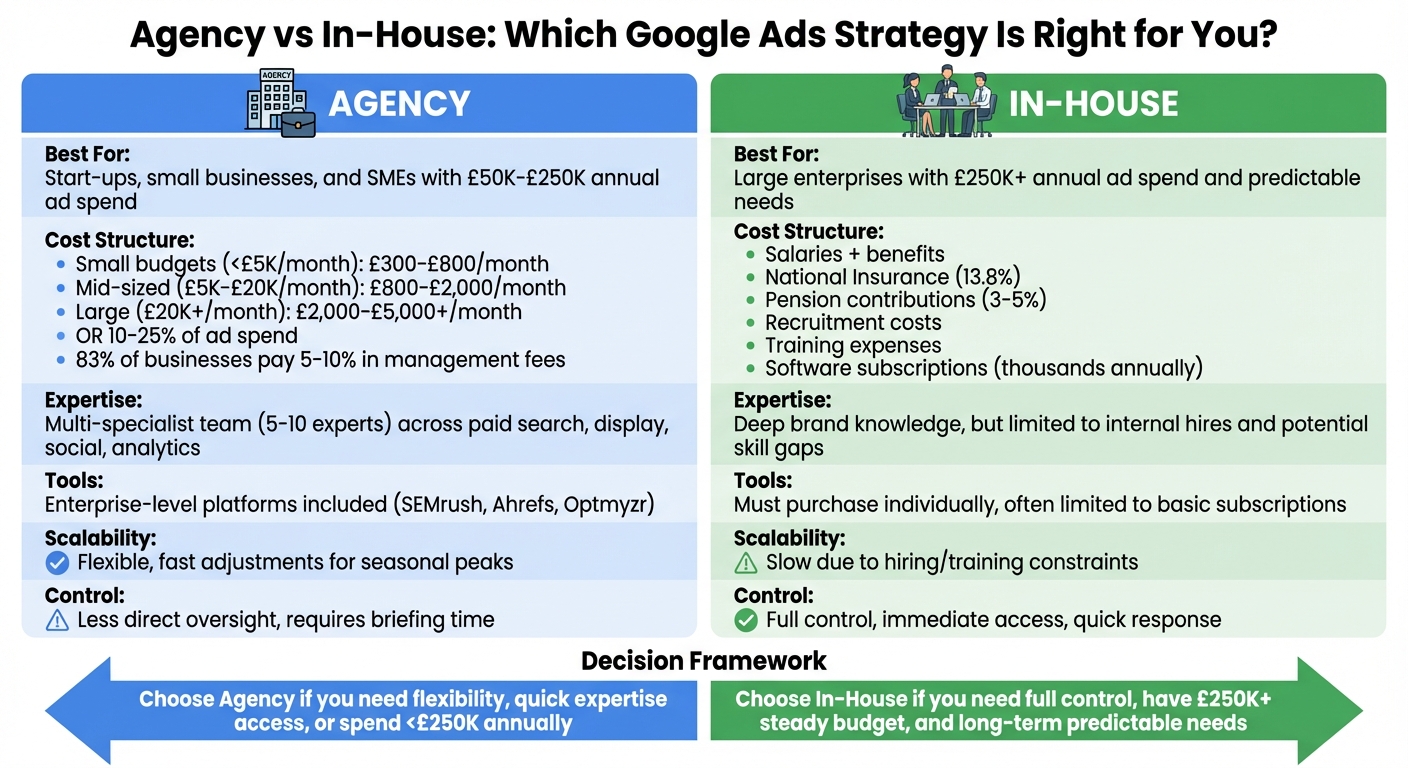
Google Ads Agency vs In-House Team Comparison: Costs, Expertise, and Scalability
Hiring A Google Ads Agency vs Hiring In House | Full Interview
What to Consider Before Making Your Decision
Before diving into a decision, it’s crucial to weigh the factors that will influence your PPC campaign’s success. Choose poorly, and you could end up wasting your budget. Choose wisely, and you set the stage for growth. Let’s break it down – your goals, budget, and team’s skills all play a role.
Your Campaign Goals and Complexity
If your campaign is straightforward – like promoting a single product or focusing on a local audience – it’s often manageable with an in-house approach. But as things get more complex, so do the risks. For example, campaigns that involve lead generation tied to offline conversions, video or image-based ads, intricate audience targeting, or multi-channel advertising require a deeper level of expertise. These kinds of challenges can quickly overwhelm a less experienced team and lead to costly errors. In such cases, bringing in expert support becomes almost a necessity.
Budget and Cost Analysis
Understanding the full financial picture is key. In-house management isn’t just about salaries – you also need to account for National Insurance contributions, pension costs (typically 3–5% under auto-enrolment), recruitment expenses, training, software subscriptions, and other overheads.
For agencies in the UK, pricing varies based on factors like your ad spend and location. Here’s a general breakdown:
- Small budgets (under £5,000/month): Retainer fees typically range from £300 to £800 per month.
- Mid-sized budgets (£5,000–£20,000/month): Fees usually fall between £800 and £2,000 per month.
- Larger budgets (£20,000+/month): Expect fees of £2,000 to £5,000 or more.
Alternatively, many agencies charge a percentage of your ad spend, often between 10% and 25%, though some go as high as 30%. According to 2025 data from WebFX, 83% of businesses spending between £1,000 and £100,000 per month on PPC paid 5–10% of their budget in agency management fees.
Keep in mind that agencies based in London can be 10–20% pricier due to higher overheads and living costs. While agency fees might seem steep at first, they can save you money over time by optimising your ad spend, avoiding costly mistakes, and offering access to premium tools that would otherwise require significant investment.
Your Team’s Skills and Resources
Managing a PPC campaign effectively demands a broad range of skills. You’ll need expertise in goal setting, keyword research, ad copywriting, budget allocation, and performance analysis. On top of that, technical tracking and staying updated on platform changes are essential.
The learning curve for in-house teams can be steep. Google Ads, for example, is constantly evolving, which means ongoing education is non-negotiable. If your team lacks these specialised skills, you’ll likely face additional training costs – not to mention the risk of avoidable mistakes. Ask yourself: can your team dedicate full-time attention to PPC without neglecting other critical priorities? If not, outsourcing might be the smarter choice.
Hiring a Google Ads Marketing Agency
When you bring in a specialist agency, you’re not just paying for someone to run your campaigns – you’re tapping into an entire team of experts in Google Ads. This team often includes graphic designers, video editors, copywriters, data analysts, and strategists, all working together to maximise your campaign’s success.
Agency Costs and Pricing Models
Agencies generally follow two pricing models: a monthly retainer fee or a percentage of your ad spend. The exact cost depends on factors like your total ad budget, the services you need, and even your location. Agencies in higher-cost regions may charge more for their expertise. For businesses with smaller ad budgets, this setup can often be a more economical option than building an in-house team.
Access to Expertise and Tools
One of the advantages of hiring an agency is their access to high-end tools for analytics, automation, and reporting – tools that might be too expensive for an individual business to invest in. Agencies with Google Premier Partner status also get early access to new features and beta programmes, giving your campaigns a potential edge.
Because agencies work with a variety of clients across different industries, they’re well-equipped to identify and fix problems quickly. As SavvyRevenue puts it:
It’s not because you’re smarter. It’s because you have seen almost everything before. And when you haven’t seen something before, then you have multiple people internally – and externally – that you can spar with to get other perspectives on how to solve the issue.
This broad experience allows agencies to spot issues like redirect errors or referral exclusions that might go unnoticed by an in-house team. Combined with their advanced tools, agencies can adjust and optimise your campaigns with speed and precision.
Scaling Your Campaigns
Agencies also offer the flexibility to scale your campaigns as needed. Whether you’re preparing for the busy Christmas shopping season or launching a new product line, they can quickly ramp up your efforts without the delays of hiring or training new staff. When demand drops, you can scale back without dealing with redundancy costs or complicated transitions.
Many agencies also provide additional services, such as social media advertising, display campaigns, or conversion rate optimisation. This means you can tap into their expertise for other areas of your marketing as needed, without increasing your internal headcount. This flexibility is especially valuable for businesses dealing with seasonal demand or exploring new opportunities.
sbb-itb-dcae4ad
Building an In-House Google Ads Team
Creating an in-house Google Ads team involves hiring, training, and retaining skilled PPC specialists. While this setup gives you full control over your ad campaigns, it also comes with notable ongoing expenses.
Cost Breakdown
The costs of running an in-house team extend beyond salaries. You’ll also need to budget for recruitment fees, benefits, pension contributions, National Insurance, training, and software tools. Essential tools for analytics, bid management, and reporting alone can run into thousands of pounds annually.
Staff turnover adds another layer of expense, including recruitment costs, the loss of valuable knowledge, and the time required to train new hires. Additionally, as Google Ads frequently updates its platform, ongoing training is a must to keep your team up-to-date.
Despite these financial commitments, having an in-house team provides unparalleled oversight of your campaigns.
Direct Control and Brand Understanding
One major advantage of an in-house team is the direct control you gain over your campaigns. You also have immediate access to the people managing them. Being closely integrated with your organisation, the team quickly develops a deep understanding of your brand, products, and customers. This alignment allows them to react swiftly to changes, such as a sudden product launch or a shift in messaging.
In-house teams also benefit from seamless collaboration with other departments, like sales, customer service, and product development. This access can significantly enhance campaign strategies and improve targeting decisions.
Scaling Limitations
That said, scaling an in-house team can be challenging. Handling peak seasons or complex, multi-product campaigns might overwhelm a small team. Unlike agencies, which can redistribute workloads across a larger pool of specialists, scaling internally often requires hiring and training more staff – a time-intensive and costly process.
When demand slows after a busy period, you may find yourself with more staff than needed, yet still responsible for their salaries. Additionally, in-house teams can struggle to keep pace with rapid platform updates and emerging trends. With fewer resources and less exposure to varied campaign types compared to agencies, they risk missing growth opportunities or falling behind competitors.
Agency vs In-House: Side-by-Side Comparison
After exploring the details of both agency and in-house options, here’s a concise comparison to outline the key differences and guide your decision-making process.
Comparison Table: Agency vs In-House
| Factor | Agency | In-House Team |
|---|---|---|
| Cost Structure | Monthly retainer or percentage of ad spend; includes tools and training fees | Fixed costs like salaries, National Insurance, pensions, recruitment, benefits, and software |
| Expertise & Specialisation | Teams of 5–10 specialists in paid search, display, social, and analytics; experience across sectors | Strong brand and product knowledge, but limited channel expertise and potential skill gaps |
| Access to Tools | Enterprise-level platforms (SEMrush, Ahrefs, Optmyzr); early access via Google Premier Partner | Requires purchasing and justifying tools individually; often limited to basic subscriptions |
| Scalability | Quickly adjusts to seasonal peaks or product launches; flexible, no long-term contracts | Scaling requires hiring and training; reducing capacity is challenging with permanent contracts |
| Control & Speed | Less direct oversight; may require additional briefing time | Immediate team access; quicker response to internal changes and messaging shifts |
| Long-Term Value | More cost-effective for short-term or dynamic needs | More cost-effective for businesses spending over £250,000 annually on ads |
Each approach has its strengths and challenges, which depend on your business goals and circumstances.
Which Option Suits Your Business Type
From the comparison above, it’s easier to see how different businesses might align with each option:
Start-ups and small businesses benefit from the flexibility and expertise of agencies. Without the need for long-term commitments to salaries or software, agencies provide an agile solution that reduces risks and allows for quick scaling.
For SMEs with ad budgets between £50,000 and £250,000 annually, agencies often make more sense. Building an in-house team with the same level of multi-channel expertise and access to advanced tools can be both costly and time-consuming. As Powered by Search puts it:
It’s unrealistic to expect a single in-house marketer to have the combined expertise as several specialized marketers working at an agency
Larger enterprises with steady ad spend exceeding £250,000 might find it worthwhile to invest in an in-house team. This option provides greater control over branding and could be more cost-efficient in the long run. However, even large organisations may face challenges when scaling during peak periods or staying ahead in all channels.
For shorter-term needs, like setting up advanced tracking systems or entering a new market, agencies are often the faster and more practical choice without the commitment of hiring full-time staff.
Conclusion: Making the Right Choice for Your Business
Deciding between hiring an agency or building an in-house team isn’t about finding a universal solution – it’s about identifying what works best for your specific needs and ensuring you get the most value for your investment.
For smaller businesses or start-ups, partnering with an agency can be a smart move. It provides instant access to specialised expertise without the added burden of paying salaries, National Insurance contributions (currently 13.8%), and pension commitments (a minimum of 3%). On the other hand, larger organisations with bigger advertising budgets might see more value in having an in-house team. This approach offers direct control over branding efforts, though it comes with the challenge of keeping up with platform changes and scaling demands.
The key is to evaluate your marketing objectives and compare them with your team’s abilities. Think about your budget, the complexity of your campaigns, and whether you’ll need to scale quickly for seasonal promotions or product launches.
If you’re still unsure which route is best for your business, consider taking advantage of The PPC Team’s free PPC audit. It’s designed to assess your current performance and pinpoint growth opportunities, giving you the confidence to make a well-informed decision.
FAQs
What are the main benefits of hiring a Google Ads agency instead of building an in-house team?
Hiring a Google Ads agency can be a smart move if you’re looking to save time and tap into expert knowledge. These agencies bring years of experience managing campaigns across different industries, ensuring your ads are fine-tuned to deliver the best possible results. Plus, they often have access to advanced tools that might not be available to your in-house team.
Another advantage? They can adapt to your business needs as you grow. Whether you’re scaling up or refining your strategy, an agency can offer flexible solutions that align with your goals. On top of that, they provide detailed analytics to help you make informed decisions and often integrate your ads with broader marketing strategies across multiple platforms. For businesses aiming to see results fast – without the hassle of building and training an internal team – partnering with an agency can be a game-changer.
How can I decide whether to hire a Google Ads agency or build an in-house team?
When deciding, start by assessing your monthly advertising budget. If you’re working with over £3,000, hiring an agency might make more sense. They bring specialised skills, access to advanced tools, and scalable solutions that can maximise your investment. On the other hand, if your budget is smaller, managing campaigns with an in-house team could be more economical. This approach offers greater control and flexibility but may require spending extra on training and resources.
Think about your business objectives, how complex your campaigns are, and how much time you can commit to overseeing them. Agencies typically come with a wealth of experience and valuable insights, while an in-house team lets you customise strategies to align closely with your company’s unique needs. Carefully weigh these factors to determine the best option for your circumstances.
What key skills are needed to manage Google Ads in-house?
Managing Google Ads internally calls for a mix of technical know-how and strategic thinking. To run successful campaigns, you’ll need to master keyword research, craft compelling ad copy, and fine-tune campaign performance to connect with your audience effectively.
Equally important are data analysis skills for keeping tabs on performance metrics and making smart adjustments. You’ll also need a solid grasp of the Google Ads platform, expertise in budget allocation, and a thorough understanding of your target audience and industry trends to maximise campaign impact.