
The Truth About Google Ads Management: What Clients Need to Know
Google Ads management isn’t as simple as setting up a campaign and letting it run. To make your budget work effectively, you need continuous monitoring, precise targeting, and smart adjustments. Businesses often lose money due to common mistakes like relying on vanity metrics (clicks and impressions), overspending on poor keywords, or skipping professional expertise. Here’s what you need to know:
- It’s not “set and forget”: Campaigns need constant fine-tuning to stay effective. Ignoring this leads to wasted spend and missed opportunities.
- Bigger budgets don’t guarantee success: Optimisation, not just spending, drives better results. Ads with higher Quality Scores perform better at lower costs.
- DIY can cost more in the long run: Mismanaged campaigns often lead to higher costs, lower ROI, and missed conversions.
Professional managers bring expertise, advanced tools, and strategies to reduce wasted spend and improve results. They focus on metrics like Quality Score, ROAS (Return on Ad Spend), and conversion rates to ensure your campaigns deliver real business growth. If you want to avoid throwing money at ineffective campaigns, investing in professional oversight is often the smarter choice.
5 Biggest Google Ads Lessons [13 Years Experience $50M Ad Spend]
Common Misconceptions About Google Ads Management
Many businesses unknowingly fall into traps that hinder their Google Ads campaigns, leading to wasted budgets and underwhelming results. Recognising these misconceptions is a crucial step towards improving your paid search performance.
Misconception 1: Google Ads Is a ‘Set and Forget’ Platform
One of the most damaging assumptions is that Google Ads campaigns can run themselves. The truth? Google Ads operates in a constantly changing landscape that requires ongoing attention and fine-tuning. Without regular monitoring, businesses risk overspending on underperforming keywords and missing out on valuable opportunities.
"PPC management is a continual process of testing and getting things right, and the data needed to make decisions won’t be available after your first 30 days." – Danielle Strouther, Marketing Product Expert, Adzooma
Effective campaign management involves frequent A/B testing to identify the most engaging ad copy, updating negative keyword lists to avoid irrelevant clicks, and interpreting performance trends to understand what truly resonates with your audience . While AI tools can assist with automation, human oversight is essential to grasp the "why" behind the numbers.
Misconception 2: Higher Budgets Always Equal Better Results
Another common mistake is assuming that simply increasing your budget will lead to better outcomes. In reality, success depends more on optimisation than on the size of your budget. Without proper management, a larger budget can result in wasted spend on irrelevant or poorly targeted keywords .
What really drives success is your Quality Score – a metric that considers your expected click-through rate, ad relevance, and landing page experience. Ads with higher Quality Scores often achieve better placements at lower costs, even when competing against campaigns with bigger budgets but poor optimisation .
For example, a case study from Intuit Solutions illustrates how refining keyword targeting can transform results. By shifting focus to highly relevant, intent-driven terms, they boosted their ROI from £1.87 to £8.75. This demonstrates that precision – targeting specific demographics, devices, and geographic locations – matters far more than simply spending more . Long-tail keywords, which are typically less competitive, can also lower costs while attracting users with a higher likelihood of conversion.
Misconception 3: DIY Campaign Management Saves Money
Managing Google Ads campaigns in-house might seem like a cost-saving move, but it often leads to costly mistakes. Inexperienced managers frequently mishandle negative keywords and match types, wasting money on clicks that fail to convert . Without consistent monitoring, underperforming keywords can quickly drain your budget .
DIY efforts often result in lower Quality Scores due to poorly structured ad groups or irrelevant keywords, directly increasing cost-per-click and lowering ad visibility . Even a single-point improvement in Quality Score can reduce cost per conversion by 15.99%. Additionally, sending traffic to generic homepages instead of tailored landing pages can significantly harm conversion rates. Other technical errors, like ad disapprovals or improper conversion tracking, can make it impossible to measure ROI accurately .
While Google Ads offers the potential for an impressive return – up to £8 for every £1 spent – achieving this requires professional expertise and ongoing optimisation.
Addressing these misconceptions and investing in professional management can make all the difference in achieving successful, cost-effective campaigns.
Why Professional Management Delivers Better Results
Professional management can significantly reduce wasted ad spend. A staggering 61% of ad budgets are lost on ineffective search terms, with the median waste reaching as high as 75.80%. This inefficiency has a direct impact on costs – every 10% increase in wasted ad spend can drive up the cost-per-conversion by 44% to 72%. Now, consider this: 27% of all media spend on Google Ads is constrained by budget, leading to a global loss of approximately £107.4 billion in potential revenue. Professional management doesn’t just optimise your existing budget – it helps you identify when budget limitations are causing you to miss out on valuable opportunities. This level of control lays the groundwork for more effective strategies and smarter campaign execution.
Expert Knowledge and Strategy Development
The expertise of professional PPC managers goes far beyond simply plugging leaks in your budget. They bring a deep technical understanding to the table, including how to handle complex settings like Consent Mode v2, which became mandatory in March 2024 for compliance in the UK and EEA. Mismanaging these settings doesn’t just risk compliance – it can also compromise reporting accuracy and limit your ability to target the right audience.
Professionals also know how to balance Google’s AI automation with human oversight. For instance, while Performance Max campaigns use AI to optimise ad placements and designs, experts ensure these campaigns maintain brand safety and transparency. As Danielle Strouther, Marketing Product Expert at Adzooma, explains:
"AI should go hand in hand with humans, not replace it".
This partnership between AI and human expertise combines the efficiency of 24/7 automated monitoring with the creative strategy and emotional intelligence that only people can provide. Another key area where professionals excel is keyword management. By focusing on long-tail keywords – which account for roughly 70% of all searches – they can target high-intent consumers at lower costs. They also implement advanced negative keyword strategies, like ensuring a fruit juice vendor avoids irrelevant traffic by excluding terms such as "alcohol" or "vodka". These detailed optimisations, along with well-informed bidding strategies based on historical data, directly contribute to better results.
Access to Advanced Tools and Resources
Professional managers have access to tools like Google Ads Editor, which allows for bulk edits across accounts much faster than manual updates. This efficiency enables them to optimise campaigns at scale, quickly identifying and addressing underperforming elements to boost returns. Advanced tracking systems provide granular insights, revealing where customers drop off and which keywords drive the most value. Instead of relying solely on basic metrics like form submissions, professionals set up meaningful conversion tracking, such as monitoring phone calls or engaged-view conversions. This is critical, given that 42.3% of Google Ads accounts lack any conversion tracking, and even among those that do, only 50.1% track truly relevant performance data.
Additionally, third-party optimisation tools – ranging in cost from £15 to £800 per month – offer capabilities like fraud detection and trend analysis that DIY users often overlook. These tools can flag wasted budgets and highlight seasonal market trends, safeguarding your investment. Considering Google processes approximately 16.4 billion searches daily as of 2025, having access to advanced analytical tools isn’t just helpful – it’s essential.
Value of Free PPC Audits from The PPC Team
One of the most effective ways to unlock these benefits is through a professional PPC audit. The PPC Team offers free audits that delve into your account structure, keyword targeting, Quality Scores, and conversion tracking setup to pinpoint inefficiencies. These audits often reveal issues like campaigns running out of budget too early, which leads to missed customer opportunities and inflated costs-per-click.
The audit also assesses whether your campaigns operate under rigid, fixed monthly budgets or a more flexible, demand-driven approach. Campaigns with fewer budget constraints typically achieve a 30% higher return on ad spend (ROAS). By uncovering technical problems – such as poor landing page experiences, incorrect match types, or ad disapprovals – a professional audit provides a clear roadmap for turning underperforming campaigns into profitable ones.
Perhaps most importantly, the audit establishes a baseline for improvement. Well-managed accounts with proper tracking boast a median conversion rate of 3.16%, which is 50% higher than the average for all tracked accounts. With the potential to achieve an £8 return for every £1 spent on Google Ads, understanding where your campaigns currently stand is the first step towards maximising their performance.
sbb-itb-dcae4ad
Key Tools and Practices for Effective Google Ads Management
The secret to turning a struggling campaign into a profitable one often lies in the tools and strategies you employ. Professional managers rely on specialised systems to navigate the complexities of Google Ads, ensuring every penny of your advertising budget is put to good use. These tools go beyond basic management, offering real-time insights that can significantly enhance your campaign’s performance.
Google Ads Editor: Simplifying Bulk Edits
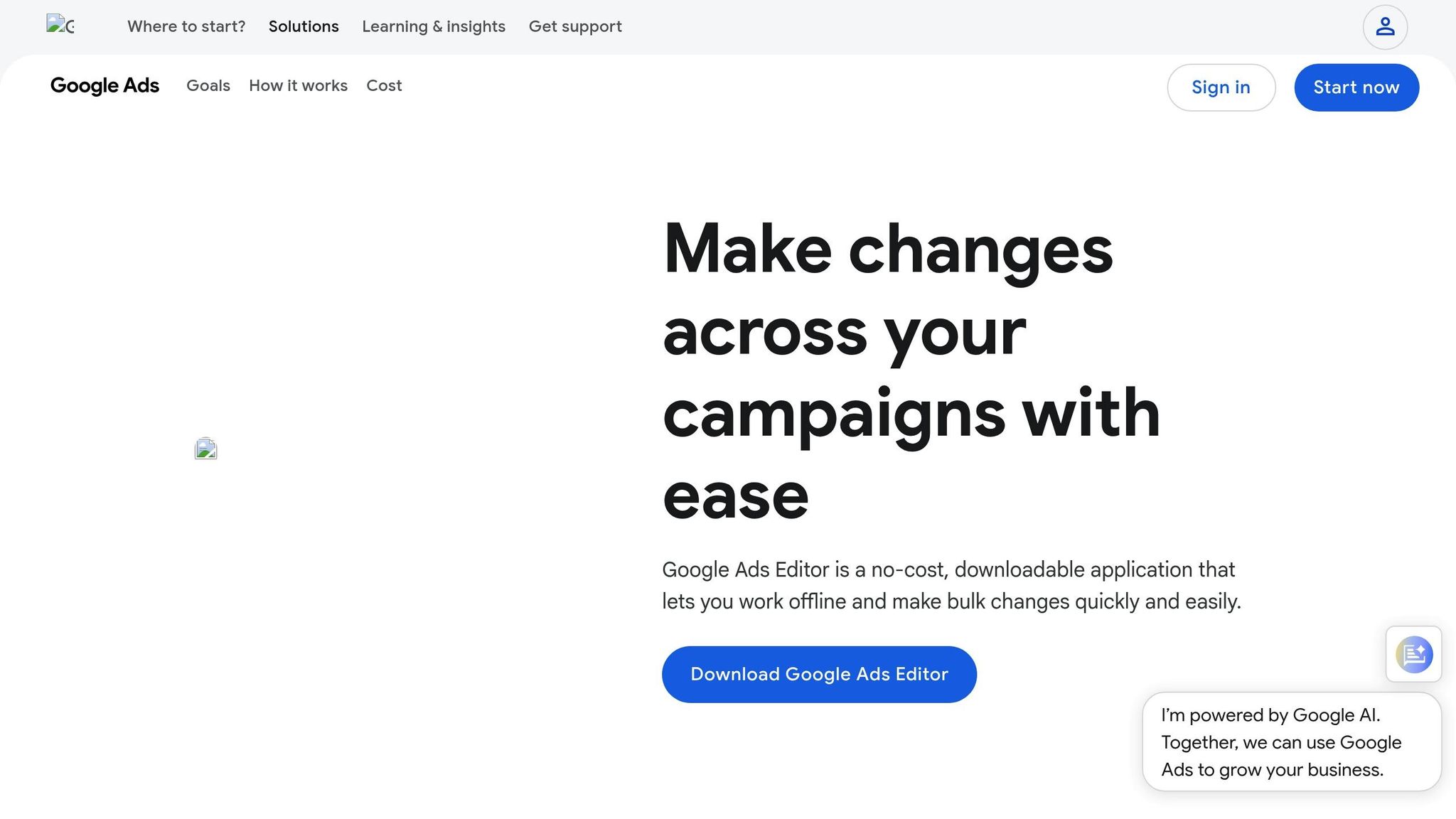
Google Ads Editor is a free desktop tool that makes managing campaigns far more efficient. It allows you to work offline, perform bulk edits across multiple campaigns, and preview changes before implementing them. For example, you can use it to search and replace text, move items between ad groups, or make sweeping updates like adding thousands of keywords in one go. The draft environment is particularly helpful for reviewing edits, reducing the risk of costly errors. You can even export campaign drafts to share with your team for feedback and approval before going live.
The "Make multiple changes" feature stands out for large-scale updates, while its offline capabilities ensure you can work uninterrupted. It’s a must-have for anyone managing complex campaigns or handling high volumes of data.
Performance Tracking Systems and Conversion Tools
Tracking tools are essential for understanding how your campaigns are performing. Google Ads Conversion Tracking is a key resource for measuring actions like purchases, phone calls, app downloads, and newsletter sign-ups. When linked with Google Analytics, it provides a complete picture of what happens after someone clicks on your ad.
As Google Business Resources points out:
"Successful Google Ads campaigns require consistent monitoring and analysing of your ad performance. This allows you to react and optimise." – Google Business Resources
To get the most out of these tools, define specific conversion actions for each goal – whether that’s a phone call or a website sale – and choose an attribution model that accurately reflects how various interactions lead to conversions. Tools like the Google Ads Report Editor and the mobile app also make it easier to visualise data and make timely adjustments.
Fine-Tuning Ad Groups, Keywords, and Negative Keywords
Effective keyword and ad group management are at the heart of a successful campaign. Structuring ad groups around narrow, specific themes ensures your ads are highly relevant to user searches. Ideally, aim for a conversion rate between 2–5% and a click-through rate (CTR) of 4–8%. To achieve this, focus on targeted two- to three-word phrases rather than single, broad terms, which often lead to irrelevant traffic and higher competition.
Negative keywords are equally important. They help filter out unrelated searches, ensuring your budget is spent only on clicks that have real potential to drive business. As Google Ads Help explains:
"By filtering out searches that aren’t relevant or specific enough, you ensure that you’re only paying for clicks that bring in business for you." – Google Ads Help
Start with at least three negative keywords per ad group and maintain a minimum of three ads per group with optimised ad rotation. Using long-tail keywords – phrases with three or more words – can also lower costs and attract users who are further along in the buying process. For best results, aim for a Quality Score of 7–10, as lower scores can limit your ad’s visibility.
Finally, align your campaigns and ad groups with your website’s structure. This not only keeps things consistent but also helps preserve historical performance data, which is crucial for AI optimisation. Avoid reorganising campaigns later, as doing so can erase valuable insights and disrupt the learning process.
Measuring Campaign Success and Avoiding Common Pitfalls
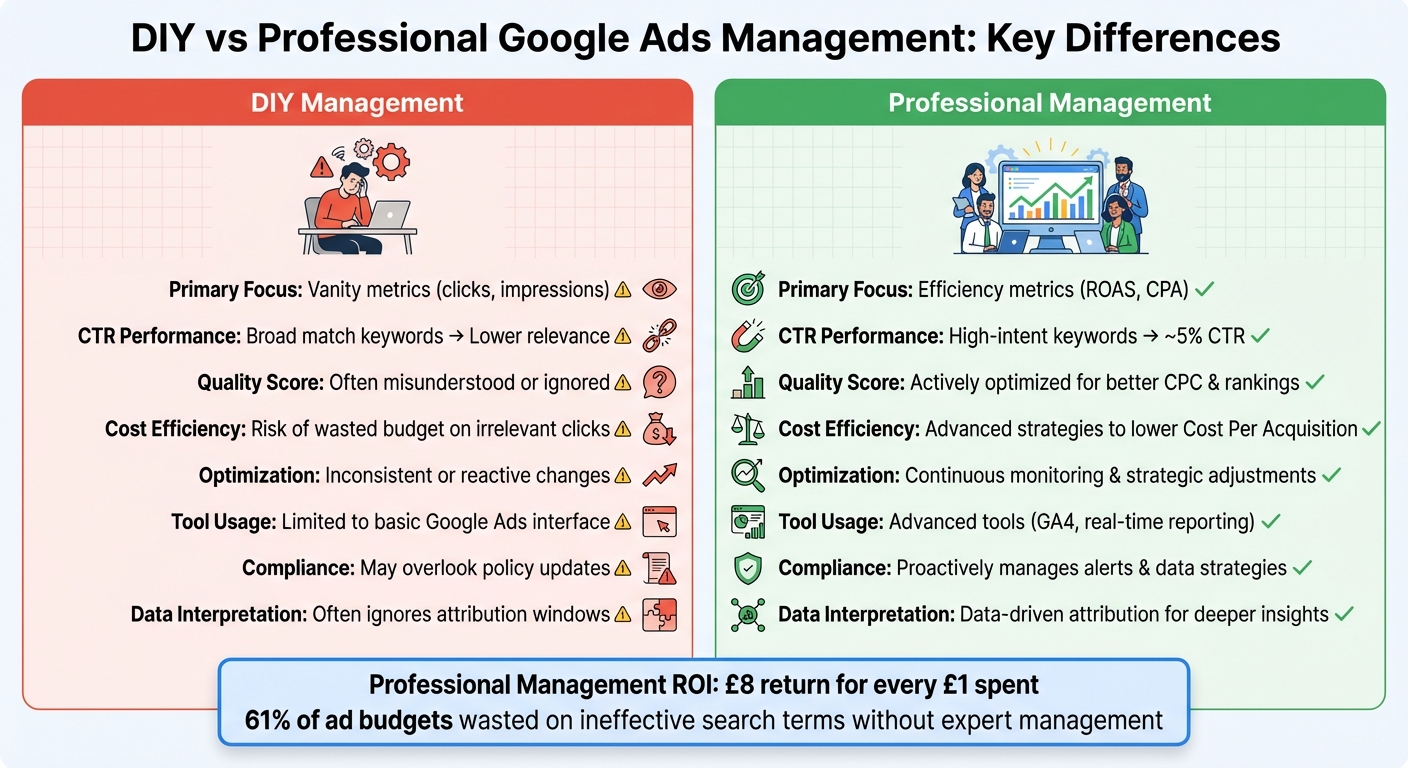
DIY vs Professional Google Ads Management Comparison
When it comes to Google Ads, success isn’t just about tracking clicks or impressions. Metrics like Click-Through Rate (CTR) offer a glimpse into how well your ads are engaging users. For reference, the average CTR across industries in 2024 is 6.42%, but this can vary significantly depending on the sector. A CTR below 1% on the Search Network often signals that your ads aren’t resonating with the right audience. However, a high CTR alone doesn’t tell the whole story. Pair it with Conversion Rate (CVR) to see if those clicks are actually turning into customers. If you’re getting plenty of clicks but few conversions, the issue may lie with your landing page rather than your ad copy.
Quality Score plays a crucial role in determining your costs and ad positions. Aiming for a score between 7 and 10 can help lower your cost per click while improving ad placement. Meanwhile, Return on Ad Spend (ROAS) measures how much revenue each pound of ad spend generates, and ROI evaluates net profit relative to costs. For example, Mitsubishi Motors Canada managed to boost their ROAS by 107% in 2024 by adopting value-based Smart Bidding. Luis Machino, their Senior Manager of Digital Marketing & CRM, said:
"Innovating on how we bid using conversion values helps us reach customers more effectively and turn potential into actual results".
These metrics are essential for making informed adjustments that separate well-managed campaigns from less effective, DIY efforts.
Critical Metrics: CTR, Quality Score, and ROAS
One of the biggest mistakes advertisers make is chasing low Cost Per Click (CPC) without considering whether those clicks are converting. For instance, a £0.25 click that doesn’t convert is far more wasteful than a £2.50 click that brings in real revenue. Focusing solely on CTR without linking it to conversions can also be misleading. To get the full picture, integrate Google Ads with Google Analytics to track bounce rates, time on site, and the entire user journey.
Impression Share is another valuable metric – it reveals whether you’re missing opportunities. A high "Search IS Lost (Budget)" percentage indicates that you need more funding, while "Search IS Lost (Rank)" suggests you need to improve your Quality Score or increase your bids. Patience is also key; conversion data can take up to two weeks to fully materialise. Professional campaign managers understand these nuances and adjust their strategies accordingly, whereas DIY approaches often lead to premature changes and wasted budgets.
Compliance with UK Advertising Regulations
Metrics alone won’t ensure success – compliance with UK advertising regulations is equally important. Set up email notifications in your Google Ads account under "Setup and Preferences" to stay informed about any policy violations. Your landing pages also play a major role in campaign effectiveness. Google evaluates landing page experience as part of your Quality Score, so poor relevance or transparency can lead to disapprovals or lower rankings.
With privacy regulations tightening and third-party cookies fading out, collecting first-party data directly from your audience is becoming increasingly important. Regularly review your search terms report to identify irrelevant queries, and add them as negative keywords to avoid wasting money on clicks that don’t align with your goals. For UK campaigns, featuring verified reviews from platforms like Reviews.co.uk or Feefo in your ad extensions can enhance trust and align with local expectations for transparency.
Comparison Table: DIY Management vs Professional Management
| Feature | DIY Management | Professional Management |
|---|---|---|
| Primary Focus | Often focuses on vanity metrics like clicks | Prioritises efficiency metrics like ROAS and CPA |
| CTR Performance | Relies on broad match keywords, lowering relevance | Targets high-intent keywords for ~5% CTR |
| Quality Score | Often misunderstood or ignored | Actively optimised to improve CPC and rankings |
| Cost Efficiency | Risks wasting budget on irrelevant clicks | Uses advanced strategies to lower Cost Per Acquisition |
| Optimisation Approach | Inconsistent or reactive changes | Continuous monitoring and strategic adjustments |
| Tool Usage | Limited to basic Google Ads interface | Leverages advanced tools like GA4 and real-time reporting |
| Compliance | May overlook policy and privacy updates | Proactively manages alerts and data strategies |
| Data Interpretation | Often ignores attribution windows | Uses data-driven attribution for deeper insights |
These distinctions highlight why professional management is often the smarter choice for maximising the potential of your Google Ads campaigns.
Conclusion: Key Takeaways for Clients
Managing Google Ads isn’t a “set it and forget it” task – it requires constant attention, strategic tweaks, and a deep understanding of the platform. While handling it yourself might seem like a way to save money, effective management typically requires around two hours daily. That’s time you could be dedicating to growing your business.
When done right, Google Ads can deliver an impressive return, with an average ROI of £8 for every £1 spent. Professionals bring the skills needed to refine bidding strategies, improve Quality Scores, and target more effectively with long-tail keywords. Their expertise ensures every pound is spent wisely, turning ad spend into real business results.
The numbers make a clear case for expert management. Partnering with The PPC Team gives you access to advanced tools, strategic oversight, and detailed reporting that transform your advertising budget into measurable growth. Their free PPC audit reveals where your campaigns are losing money and missing opportunities. Instead of seeing professional management as an extra expense, think of it as an investment that often pays for itself through better returns and reduced waste.
The most successful clients know that collaboration is essential. By setting clear goals, engaging in regular strategy discussions, and trusting the insights provided by your PPC expert, you can maximise results. Metrics like CTR, Quality Score, and ROAS are only meaningful when interpreted correctly and acted upon. With professional management, you’re building a reliable advertising system that delivers consistent outcomes – leaving you free to focus on what you do best.
FAQs
Why is ongoing management crucial for the success of Google Ads campaigns?
Keeping Google Ads campaigns running effectively isn’t a “set it and forget it” task. To ensure your ads perform well and deliver results, ongoing management is crucial. Regular tweaks and updates help your ads stay in sync with evolving trends, shifts in audience behaviour, and changes on the platform itself. Without this, campaigns can quickly drain your budget without delivering the desired impact.
Consistently reviewing performance data allows advertisers to fine-tune targeting, enhance ad quality, and get the most out of their investment. This hands-on approach not only ensures your campaigns remain competitive but also helps you make the most of every pound spent on advertising.
How does improving Quality Score help lower Google Ads costs?
A higher Quality Score can make a big difference in your Google Ads expenses. It helps boost your ad’s position without needing to raise your bids, meaning you could end up paying less per click while still securing a top spot.
The Quality Score measures how relevant and helpful your ad is to users. It takes into account factors like ad relevance, click-through rate (CTR), and the landing page experience. By improving these elements, you can fine-tune your campaigns for better results and lower costs.
What are the advantages of hiring a professional to manage Google Ads?
Working with a professional to manage your Google Ads campaigns can offer a range of benefits that go far beyond just setting up ads. A skilled PPC expert brings experience and strategic thinking to the table, using data-driven techniques to cut down on unnecessary spending, fine-tune keyword strategies, and adjust bids effectively. This often translates into a stronger return on ad spend (ROAS) and a clearer picture of how your ads are performing.
Handing over the reins to a specialist also frees up your time, allowing you to focus on running your business while they take care of the technical side. From using tools like Google Ads Editor to advanced bid management systems and performance tracking, they ensure every aspect of your campaign is optimised. Plus, professionals stay informed on Google’s latest policies and ad formats, keeping your campaigns compliant and competitive. The payoff? Greater efficiency, easier scaling, and a more consistent path to growth for your business.